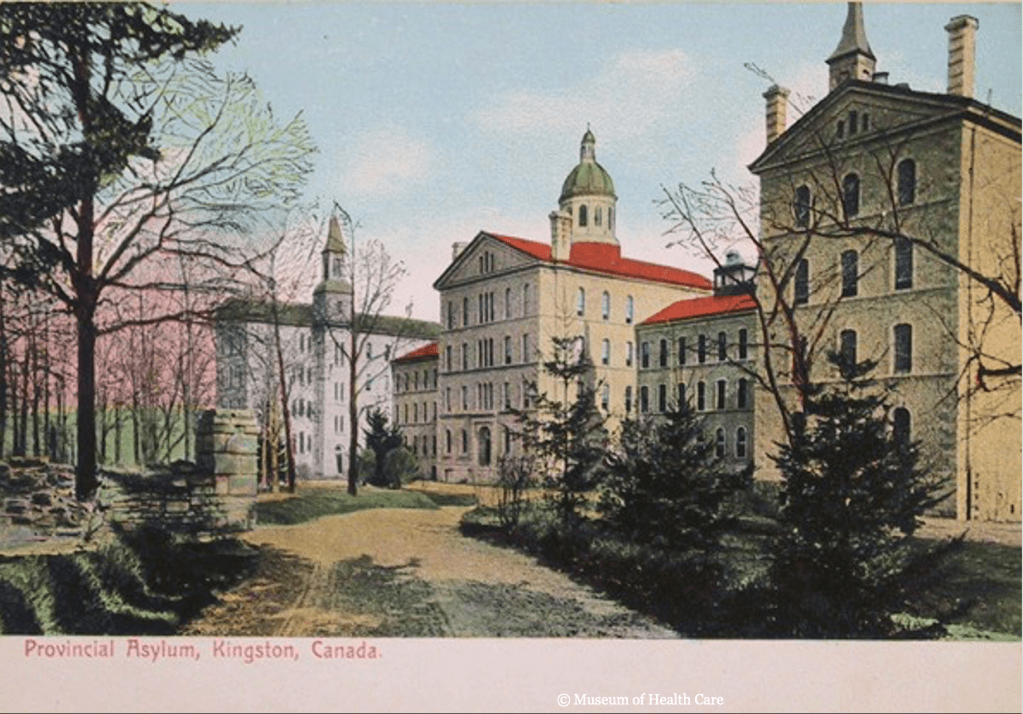
On 1 June 1869, John Murphy was admitted to the Rockwood Asylum for the Criminally Insane in Kingston, Ontario, as Patient #468. The massive limestone complex on the shore of Lake Ontario had been under construction since the autumn of 1859, built by gangs of convicts from nearby Kingston Penitentiary, and was completed a year before John Murphy’s arrival. He was an Irish-born Catholic labourer who had been sent on to Kingston from the Peterborough Gaol (The GMM Project Team’s next trip to the Archives of Ontario will include a thorough searching of the available microfilm from the jail in the 1860s for any trace of Murphy’s case).
John’s medical file from the asylum notes that he had been insane for “several years before admission. He had become quite unmanageable at times” and “would usually be alone in some obscure place.” At the family farm, he had tried to kill his sister-in-law with a knife and assaulted his brother with a pitchfork. The supposed cause of his homicidal mania was masturbation.

There were no medical notations made on his file between his admission to the lunatic asylum in 1869 and a change of handwriting in 1880, some eleven years later. By this time, John had become “a good, industriously inclined man” with clean bodily habits and good physical health, owing to his work outdoors on the asylum’s farm and garden. Three years later, in 1883, he was still considered “quiet, harmless, and a good worker.”
But things changed a few months later.

On 9 December 1883, John Murphy escaped from Rockwood. A “careful search” of the county failed to discover the “slightest trace of him.” The person filing the report believed it was “very strange that Murphy should elope as he has no place to go to, and he has always been allowed to go about as he wished.”
The next day, he was found in the asylum hayloft, covered with straw. According to his file, he was in a very weak state “from loss of blood. An examination of his person revealed the fact that he had attempted to cut off his penis with a dull chisel made from hoop iron. Fortunately for him his rude instrument would not cut well and the wound made, although wide and serious, did not extend into the ‘corpus.’ Four silver wire sutures were put in the wound.”
John Murphy is one of thousands of Irish-born patients confined at one of the three major lunatic asylums in Canada between 1841 and the 1870s. But, unlike the vast majority who ended up in either Beauport, Toronto’s Provincial Lunatic Asylum, or the Rockwood Asylum for the Criminally Insane, his case notes are considerably detailed—despite the eleven-year gap at the beginning of his file. Moreover, the sexualized nature of his initial diagnosis makes him part of a smaller, but increasingly common population within Canada’s early asylums: insane by reason of masturbation.
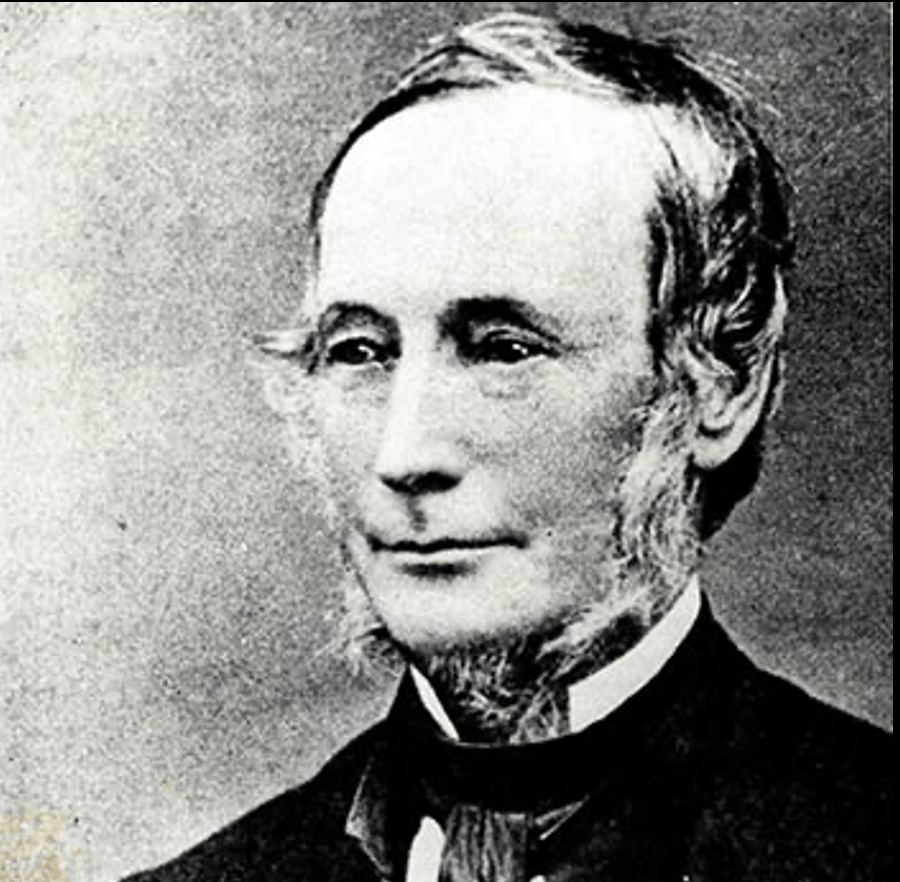
According to Dr Joseph Workman at the PLA in Toronto, masturbation was a “moral pestilence.” He dreaded to even mention it in his formal reports to the government, but he felt he had to point out that “all over this continent [it] appears to be peopling our asylums with a loathsome, abject, and hopeless multitude of inmates.” Like many physicians in the nineteenth century, Workman believed that the only way to curb self-abuse was “moral self-control.” He was only one voice among many trying to draw attention to the masturbation problem while also trying not to discuss it too much and also to eradicate its practice from society. Without a hint of irony (or any sense of what historians might make of his words some 150 years later), Workman proposed that “[n]o one in Canada occupies a position more fully qualifying to speak with assurance on this subject than myself.”
However, unlike some of his contemporaries, Joseph Workman was prepared to question if a diagnosis like that which John Murphy received, was entirely right. In some cases, he argued, masturbation had to be a symptom of mental illness rather than the cause itself. Or, as he put it himself, “If intemperance were per se, an efficient cause of insanity, surely the number of the insane would be enormous. In like manner, if masturbation be regarded per se, as an efficient cause, I dread to think how multitudinous will be the number of lunatics.” Whether a primary or secondary affliction, Workman did feel certain that “in extent, as well as in intensity, it eclipses all” other causes of insanity “put together. No other agency is now contributing so much to the peopling of our Asylums with hopeless inmates.”
Hopeless cases were not the ones that Workman wanted to accept at the asylum in Toronto, and they weren’t wanted at Rockwood, either. John Murphy remained at the Kingston asylum for seven years after his self-inflicted groin wound, where as “unimproved.” In October of 1890, he was transferred from Rockwood to the Asylum for the Insane in London, Ontario, as an “incurable.”
 Gender, Migration, and Madness Research Project