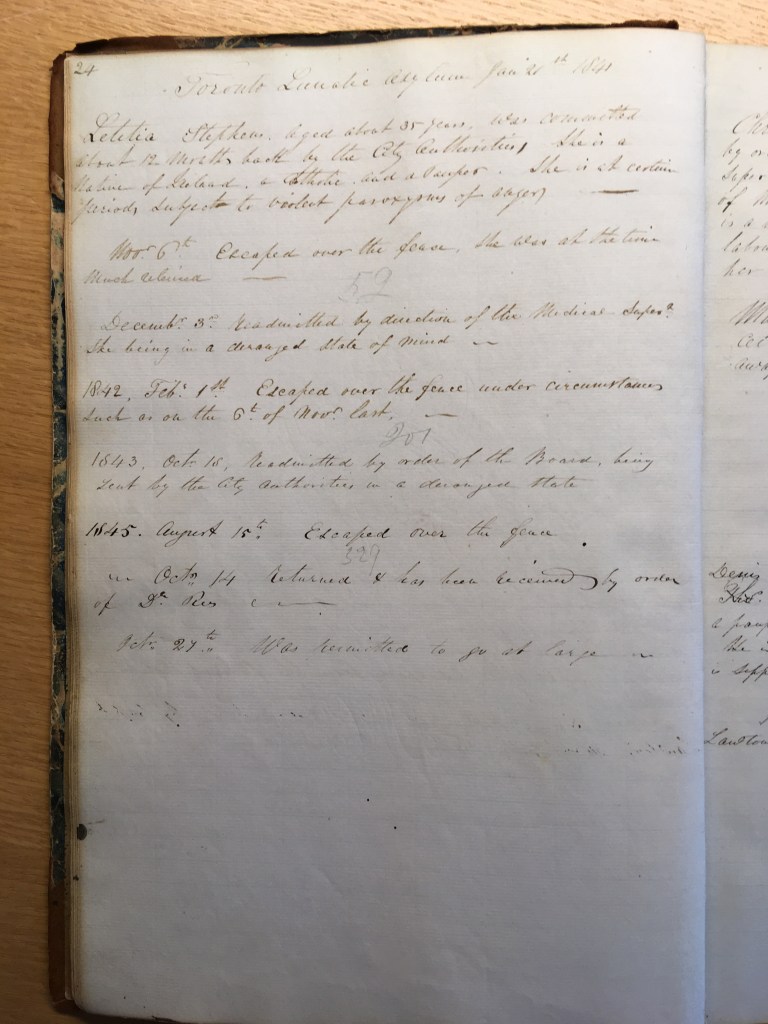
We’re not exactly sure when Letitia Stephens arrived in the Canadas, but she certainly was part of the pre-Famine wave of Irish immigrants, likely crossing the Atlantic in either the 1820s or the 1830s. Her first committal papers at the Provincial Lunatic Asylum in Toronto state that she had already been committed by the City Authorities in late 1839 or early 1840, and therefore had the dubious honour of being one of the very first patients admitted to the new provincially-run institution on 21 January 1841. This still was a temporary facility; by the end of her time in Toronto, Letitia had been held in both the temporary asylum and the permanent site at 999 Queen Street West.
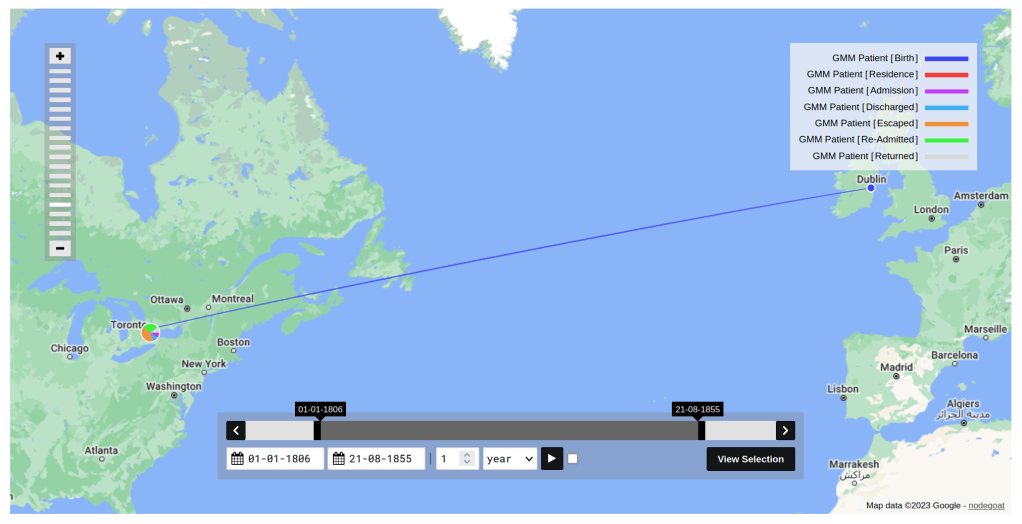
Letitia was born in Ireland, likely in or around 1806, and was thirty-five years old when first committed in Toronto. She was listed as being married, Catholic, and a pauper. She was illiterate and unemployed. There are few details about her specific medical diagnosis, but the case notes state that she was “at certain periods subject to violent paroxysms of anger.”
On 6 November 1841, nearly ten months after her first admission to the PLA, Letitia escaped. One of the reasons why she stands out in our project database is because of the number of successful escapes she undertook: five in total, over fifteen years. After she had absconded over the fence, the asylum attendants wrote that she “was at the time much relieved” – presumably this was a reference to her improved mental state rather than some last-minute expression of gratitude at having gotten away from the asylum, although the image of her waving from the other side of the fence at her keepers does give her story is tempting. She was apprehended and readmitted less than a month later on December 3rd in a “deranged state of mind.” No details were included in her file as to what she had done during her weeks on the lam.
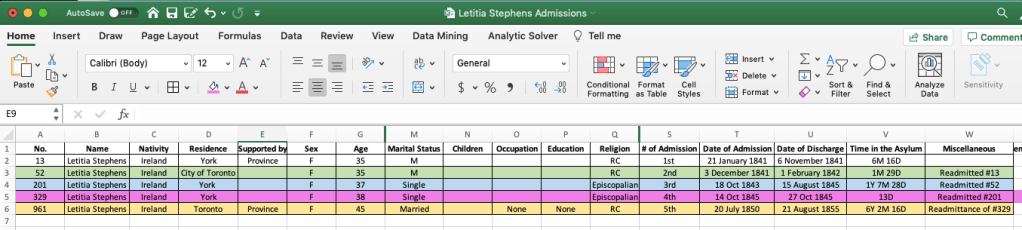
This pattern continued for some time: on 3 February 1842, Letitia escaped over the fence (again), only to be readmitted in October 1843 in “a deranged state.” This time, however, her file lists her as being single rather than married. Her religious affiliation had also changed from Catholic to Anglican.
In the summer of 1845, she again escaped by climbing the fence, only to be returned two months later. This time, however, Medical Superintendent Dr. Rees appeared to have a change of heart about her care. Less than two weeks after Letitia’s most recent return to the asylum, she was officially discharged on 27 October 1845, her file listing that she “was permitted to go at large.”
We don’t know what happened to Letitia in the intervening years, although one can presume that she stayed in the vicinity of Toronto. She was brought again to the asylum in the summer of 1850. This time, the reason for her incarceration was the “change of life.” For this admission, Letitia was listed as being married, but since the only change in her surname was a ‘v’ instead of a ‘ph’ in ‘Stephens’, it’s unclear whether or not she had remarried, or if earlier entries in the asylum ledger had been incorrect about her marital status. Did her husband bring her to the asylum? Had she been picked up by the city authorities? In many ways, Letitia’s file is exemplary for its frustrating lack of detail after giving a few tantalising glimpses of her story.
After five years in the asylum, Letitia returned to her familiar pattern and escaped again – the register often using the term ‘eloped’ rather than ‘escaped’ (which did cause a bit of initial confusion within the research team, since we’ve all apparently read too much Jane Austen). It’s unclear if she climbed the fence again or if she used a different route. She was readmitted in January 1856 before fleeing again that October.
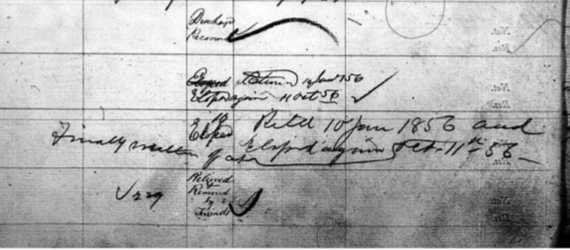
Letitia’s final entry in the asylum register is one of the most interesting from all her years of repeated incarcerations. The most recent time she had spent at the asylum was struck-through and a half-sentence notation spelled out her ultimate fate: “Finally Malden.” This meant relegation to the Fort Malden Lunatic Asylum, a military barracks from the War of 1812 south of Windsor that had been repurposed in 1859 as a branch asylum for incurable and surplus patients.
Perhaps by 1859, Dr Joseph Workman – the medical superintendent who was known to prefer treating patients with ‘curable’ mental illnesses at the downtown Toronto asylum – had grown tired of Letitia’s catch-and-release pattern. Perhaps her repeated escapes set a bad example for the other patients. Perhaps the mental illness associated with her menopause had become a form of permanent dementia. The precise answers are unclear, but we do know that Letitia Stephens is an example of an Irish patient who literally tested the boundaries of the Upper Canadian asylum system time and again, from its infancy well into the period of widespread institutionalization throughout the colony.
 Gender, Migration, and Madness Research Project